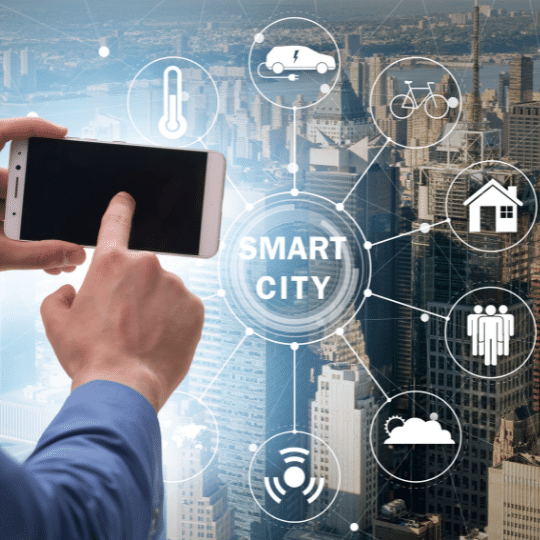
A city should be the best place to work and relax. Modern technologies make city life easier
STEFAN KOWALSKI /CEO FUTULAB
“Let’s start with the fact that the manifestation of a well-planned smart city is the satisfaction of its residents. This is why the modern smart citi concept is so important not only for residents but also for city authorities. If we add to this the important information that in the world 50 percent of the population already lives in cities and in Europe even 75 percent, we will understand what an important challenge is facing not only the authorities of cities but also the authorities of states. Because countries are slowly becoming big cities.’
A city should be the best place to work and relax.
Experts stress the extreme importance of the active participation of an informed public in the planning, creation and management of the city. This is one of the pillars of Smart City development, without which it would not be possible at all. The conscious participation of residents in this process must come from the belief that the creation and development of a smart city is not just a fad and fascination with technology, but a genuine aspiration to improve living conditions in the city. Convincing residents of this is a challenge for any city government. If residents don’t see the benefits for themselves, they won’t get involved. Example: if public transportation, thanks to the solutions used (bus lanes, traffic signal control, traffic information), operates efficiently and quickly, according to the timetables displayed at bus stops, there is a chance that many people will switch to it from private cars. This will benefit the environment and the health of residents.
“Our first project, which we realized while still in the research stage, was a scenario analysis for one of the largest Polish cities-Wroclaw”
What we create
Our ICT tool, based on the analysis of trends, creates sector-specific recommendations that form the basis for further analysis. To simplify-it is an analyst support tool that automates the data prediction part of the work and is additionally supported by semantic analysis of content. This analysis makes it possible to assess the probability of occurrence for particular scenarios. The company offers an information system to support the implementation of the foresight process, based on Scenario Trend Analysis (SAT) for institutions offering services or products for the smart city.
We collect data from residents and city authorities
We subject them to a long and thorough analysis
We create scenarios so you can choose the best solution
The idea of smart citi
Smart cities today do not have to be high-tech centers. That is, the road to being “smart” is open to all centers: larger and smaller. The features of a smart city are primarily:
Efficiency – in the use of infrastructure, resources, technology, and in this context one often speaks of a collaborative economy (shared economy).
Resilience – to climate change, social, economic and epidemiological crises. Adaptation – manifested by readiness for change and a constant search for new solutions and rapid response to emerging challenges.
Innovation – the city’s culture based on assessing the usefulness and possible implementation of new solutions, but also building a culture of participation, openness to civil tech and open data solutions.
We are constantly developing our product. Our scientists are working on it, Watch us, because we may already know more than when you visited us last time